
There are loads of things that I’ve wanted to do *forever*. Some are foolish and improbable (hello, climbing El Cap), and some have been impossible for all kinds of reasons which, for simplicity’s sake, I’ll bundle together as ‘force of circumstances’. I can’t remember when I first learned about Angkor Wat but I’m pretty sure I’ve wanted to go there from roughly 5 seconds later. It feels like all my life. It’s certainly a bucket list ambition. What I’m trying to say is, this whole holiday has been a dream come true, but Angkor Wat, particularly, moves into the territory of wish fulfilment.
I set my alarm for 03:45, but very much like a small child on Christmas morning, I was awake and pacing, counting down the minutes until Davin arrived, at about 02:30. It was resolutely dark outside. Which is good, because we had to go to the visitor centre to get a pass to enter the complex, before we could actually go; and I wanted to see the dawn break over Angkor Wat itself. And then I had made a detailed and complex plan of how my day would unfold.
After Angkor Wat, I planned to go to the Angkor Thom complex and see Bayon (the temple of the faces), Baphuon, Preah Palilay and Preah Pithu. Then I was going to stop for lunch before heading over to Ta Prohm and then back to the hotel.
Davin suggested that Ta Prohm would be heaving by early afternoon and I might be better going to Preah Khan instead. He said that it was far less visited and I would be able to see much more. So I agreed.
I think we were early at the visitor centre as there were barely any queues. I joined one, paid over my entrance fee and received my day pass, and I was back at the tuk-tuk within 20 minutes.
The crowds began to build as we pulled up to the Wat. Davin told me where he’d be waiting, and with indecent haste I bustled over the plastic pontoon bridge. Quite a crowd was gathering at the pond in front of the Wat, all with cameras at the ready. The temple itself opens at 05:30, and we were expecting dawn at 05:00.
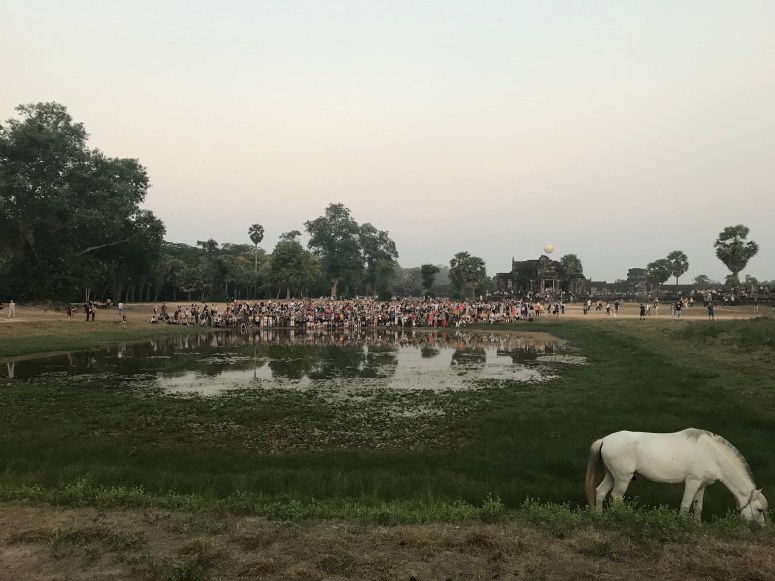
It was spectacular. I decided not to be part of the crowd, but found myself a space close to the outer wall of the temple, and watched the progression of the sunrise from there.


The crowd didn’t detract too much; in fact, I was barely conscious of them. It was just such a beautiful, heart stopping moment.
When the temple opened, I followed the route I’d planned, more or less. The outer wall of the first level is carved with bas-relief showing King Jayavarman II’s military triumphs interwoven with illustrations of various Buddhist and Hindu myths. I was particularly interested in the apsara – heavenly nymphs carved into various columns. There are more than 2000 of them in Angkor Wat alone, and they are used across Siem Reap – and presumably the rest of Cambodia – as symbols of Cambodian cultural history. I also wanted to see the churning of the ocean of milk and the representation of the journey to heaven.


I wasn’t disappointed. The temple is spectacularly beautiful. The carvings are in various stages of restoration, and even where they’re still original, are in pretty good nick considering that they were made in the 11th and 12th centuries and have been extensively vandalised by wars and occupations – not to mention lootings – since then. Most recently, the Khmer Rouge used Angkor Wat as their headquarters (they knew Cambodians would never risk destroying the temple, even to defeat them) and they systematically knocked the heads off all the statues of deities – Hindu or Buddhist; they were equal opportunities haters in that sense – and even some of the temple lions and naga snakes.
I was making my way round the bas-reliefs in a state approaching awe, when I suddenly found myself wrapped in a hug! There were Isabella and Matthias! It was so lovely to bump into them and we spent the next couple of hours exploring the Wat together.
We spotted some monks going into the courtyard of 1,000 buddhas, and followed them out of sheer curiosity. And so it was that I received my second blessing in as many days! After saying his own prayers in front of a large statue of the Buddha, the monk set out a bundle of little red and orange plaited wristlets. I asked if I could take a photo, and he offered me a string and a blessing, which I received gratefully. How awesome to be blessed in the heart of Angkor Wat! And yes, I know this is a commercial exercise designed to encourage donations, but give me this, please. It was incredibly special (also, my monk had many Sak Yant so he was obviously a bit of a dude!)


The temple walls really hold the heat and by 7am, the crowds and the heat were building in intensity and so we headed to the grounds in search of coffee.
After coffee, we went our separate ways. Isabella and Matthias also had a tuk-tuk driver with them, and were following a slightly different route.
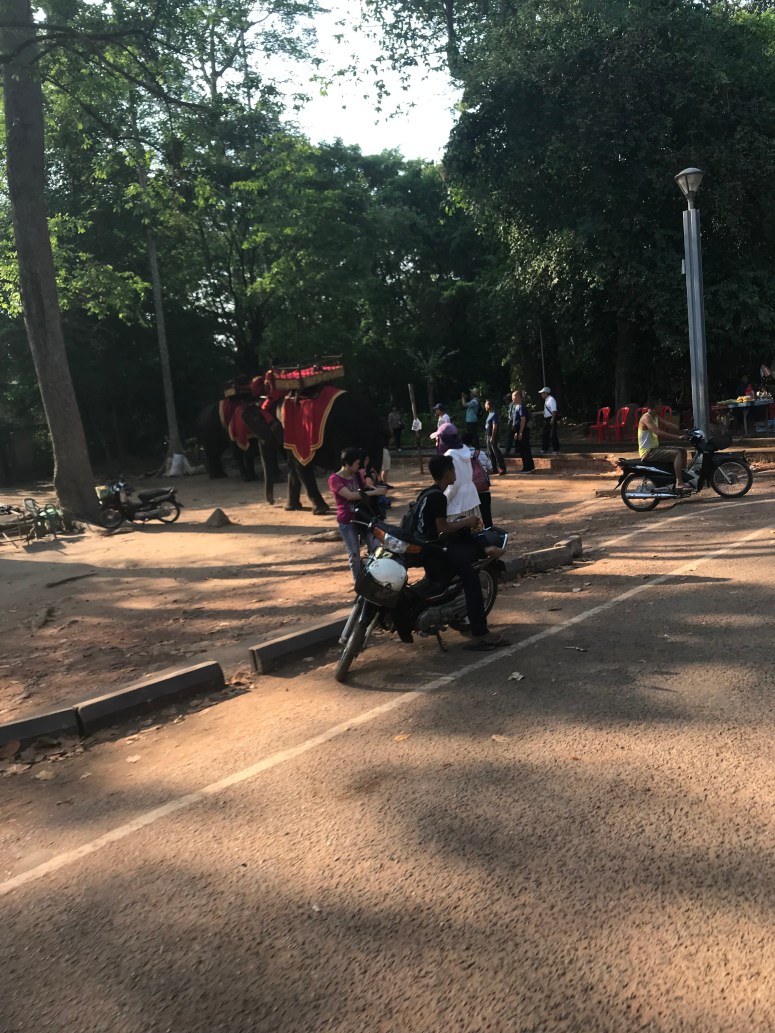
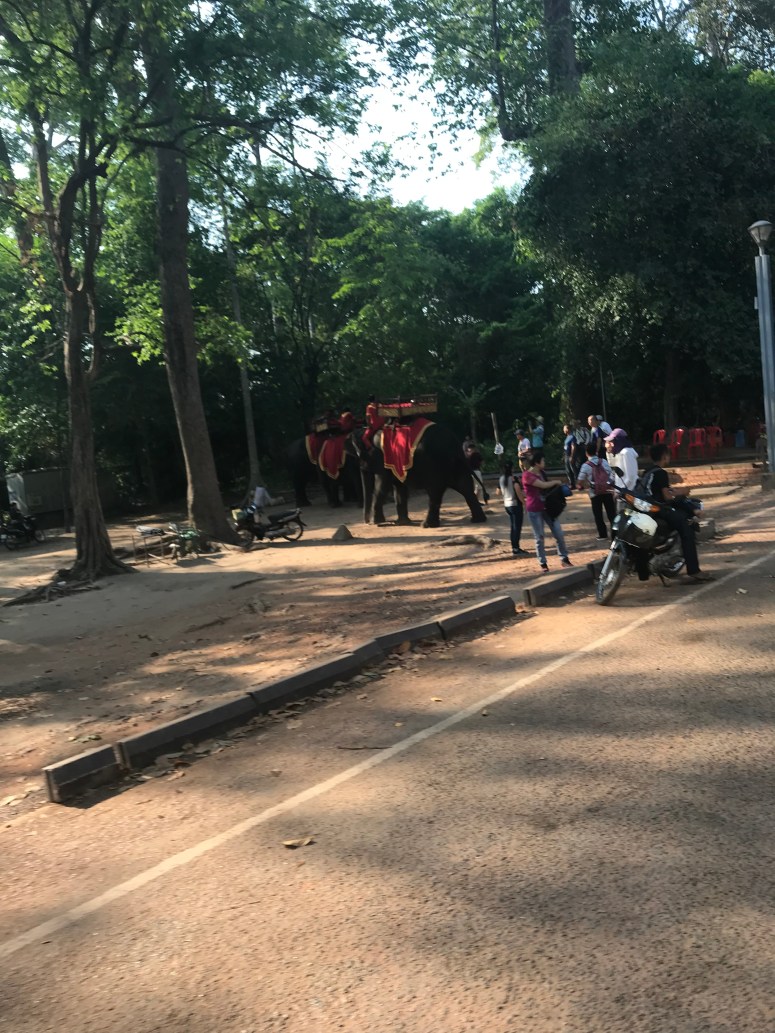
Angkor Thom is a city, containing temples, palaces, shrines and a lot more besides. The guide book reckoned it would take about four hours to get round it all. Davin was worried that I hadn’t drunk enough water, or eaten anything. So we drove to the gate, which you approach via a bridge over the moat. And we saw elephants! I mean actual elephants rather than carvings – it seems you can take a tour of Angkor Thom on an elephant!!
The bridge is guarded by naga snakes, with representations of Avalokiteshvara holding onto them. Funnily enough, on the left hand side the face of Avalokiteshvara bears a strong resemblance to King Jayavarman VII (or so the guide book says; I’ve never met the guy, myself!) who built Bayon. On the right hand side, the faces vary more and seem to have more and more varied expressions. I wondered whether they were likenesses of other members of the royal family, or courtiers….


Anyway, Davin dropped me to walk through the gate and then found us a spot for breakfast. By the time we’d eaten it was probably about 8:30 and the temperature was rising. I arranged a spot to meet Davin, took some water, and set off.
I was expecting great things of Bayon – so many people who’ve visited the area have told me it’s their favourite temple. I both was and wasn’t disappointed. The faces are certainly awe inspiring, and it’s not difficult to understand why people were (and possibly are) convinced that the gods lived here. The bas reliefs are less accomplished – apparently Jayavarman VII began building the temple when he was already quite old, and so each level was planned individually and executed in something of a hurry. But there is a great deal of beauty, even so.
My response to Bayon is also undeniably influenced by the huge crowds of guided tours. I think if I were in charge, I would limit the size of individual tours – not to reduce the numbers of visitors overall, but because a tour group of, say, 6 is far easier to navigate around than a group of 20 or even 30.


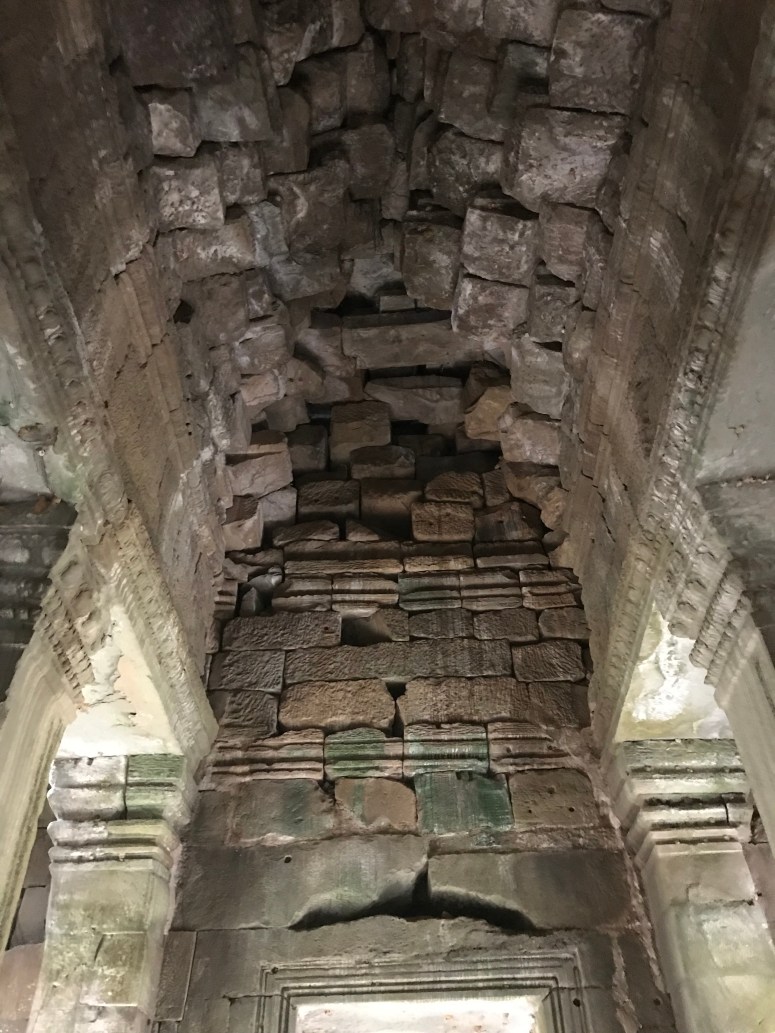
Despite the heat and the crowds, I began to develop a fascination with the ceilings. The structures of these temples are made of enormous blocks of stone, stacked (and carved) into the iconic shapes of the temples. But the interior spaces are phenomenally high, and arched. I found myself comparing them to European cathedrals, where architects and engineers understood about using flying buttresses to bear load and spread the weight of high ceilings. But if you look up in the Wats, it seems the approach taken here was more one of stacking blocks and using the opposing tensions of balanced blocks to keep the whole standing. It looks like a kind of ramshackle Lego structure, rather than a cathedral…. (the picture is actually Preah Khan, but you see my point. And the ceilings were like this in all the structures)
Leaving Bayon (not my favourite, I’m afraid) I was becoming more and more conscious of the heat. I made my way through light forest to Baphuon. This one is interesting because there was a project to restore it which involves taking it apart painstakingly, block by block, with the intention of rebuilding. However, along cane the Khmer Rouge and destroyed all the records! So since the site has been reopened work has been ongoing to try to puzzle it all together. So there are a lot of blocks lying around, waiting to be fitted back in…!


At this point, I was really too hot and becoming a bit dazed, so I couldn’t tell you much else about the history of Baphuon. The thing that most impressed me about it, though, is that the blocks on the west wall are arranged to form an enormous reclining Buddha – it was seriously impressive. In a way, more so than the more iconic faces of Bayon, because it was a single thing. You stop seeing the faces at Bayon after a while, just because there’s so damn many of them 😊
I moved on to Phimeanakas, the only surviving structure of the Royal Palace (apart from a section of wall of the Royal Enclosure, which the jungle is slowly reabsorbing). Phimeanakas itself is under restoration, so I could do little but walk past it, but that was really pleasant, being in the shade of the forest. So I did a circuit of Phimeanakas and back to the front of Baphuon so that I could follow its 200m elevated walkway down to the Terrace of the Elephants.


I have always loved elephants, ever since I was a very little girl, and this was one of the most spectacular sights – even though it is comparatively simple – for me. It is 350m long, with 5 piers extending into the central square. Each pier takes the shape of the heads of a three-headed elephant. The southern end of the terrace is also decorated with carvings of elephants, whereas the northern end seems to be dominated by Hanuman, the Hindu monkey god. The terrace was used by the royal party to view public events in the central square, and it certainly has a commanding view of everything to the east of it – which were mostly structures that I didn’t explore.


Just past the northern end of the Terrace of the Elephants is a “hidden” terrace – a kind of high sided, open topped corridor which follows something of a maze-like path. It has incredibly well preserved carvings – and absorbs the heat of the sun so was actually pretty claustrophobic!


Once out of that I had a quick look for the terrace of the leper king, which is apparently a platform on which stands an enormous naked statue which may be a representation of Yama, the god of death. I was intrigued to see this, since I mostly know of Yama from the music of Gil Scott Heron (shallow as a teaspoon, me!) and I was intrigued to see him. However, all I found was an admittedly very large Buddha, draped in saffron robes.
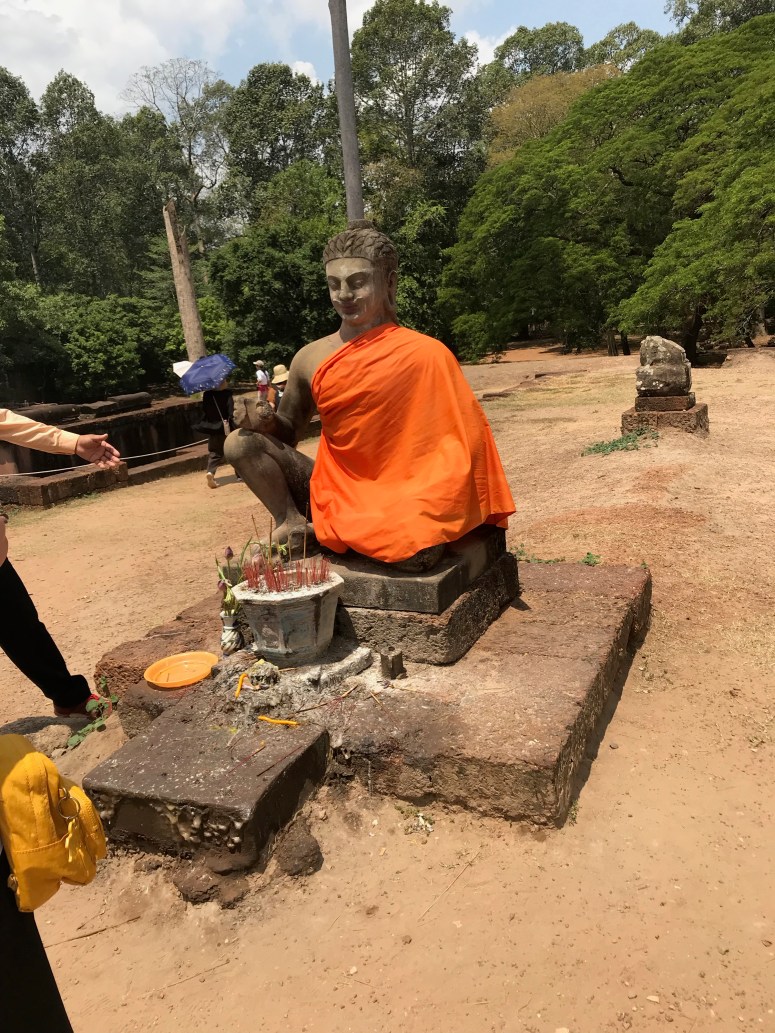
I was far too hot and becoming really listless by now, so I decided it would be more sensible to find Davin and the water than to wander around looking for a god of death who might be inclined to pay too much interest in me!
Davin, too, was feeling the heat – unsurprisingly, as the temperature was by now 39 degrees. We sat awhile and drank two or three bottles of water. I really wanted to go to Ta Prohm, but Davin advised that it would be hugely crowded. Ta Prohm is the temple where Tomb Raider (the Angelina Jolie version) was filmed and is also known for the impressive way that the trees are growing up through the ruins. It was now about 11am, which Davin said would be nearing the peak of visitor volume. He asked why Ta Prohm in particular, and I said I wanted to see a temple that the forest is reclaiming. So he suggested Preah Khan.
Preah Khan is one of the less visited temples. It’s on the grand circuit – a longer tour covering far more distance than you can sensibly manage in a tuk-tuk. But Preah Khan was within reach, would have few visitors and Davin promised I’d enjoy it – so I decided to take his advice and off we went to Preah Khan!
I think – apart from Angkor Wat itself – Preah Khan was my favourite. It is pretty comprehensively ruined, in places, but the fallen blocks are all still there and you can clamber over them. It has some spectacular statuary. Parts of it are being eaten by trees, there are amazing little shrines and the guardians are very willing to talk to you about what you’re seeing. The stone is weathered and has taken on some interesting patinations.


It’s also very easy to stay in the shade, which I was super appreciative of! So I had a very happy explore of this temple about which I know next to nothing apart from what the guide book says. So apparently, it’s one of the largest in the complex and was probably Jayavarman VII’s temporary residence while Angkor Thom was built. The walls are punctuated by holes, which apparently would have served as anchor points for the plaster that once covered them. One of the guardians showed me a pair of shrines dedicated to princesses which were obviously well used, despite being well disguised in rubble.
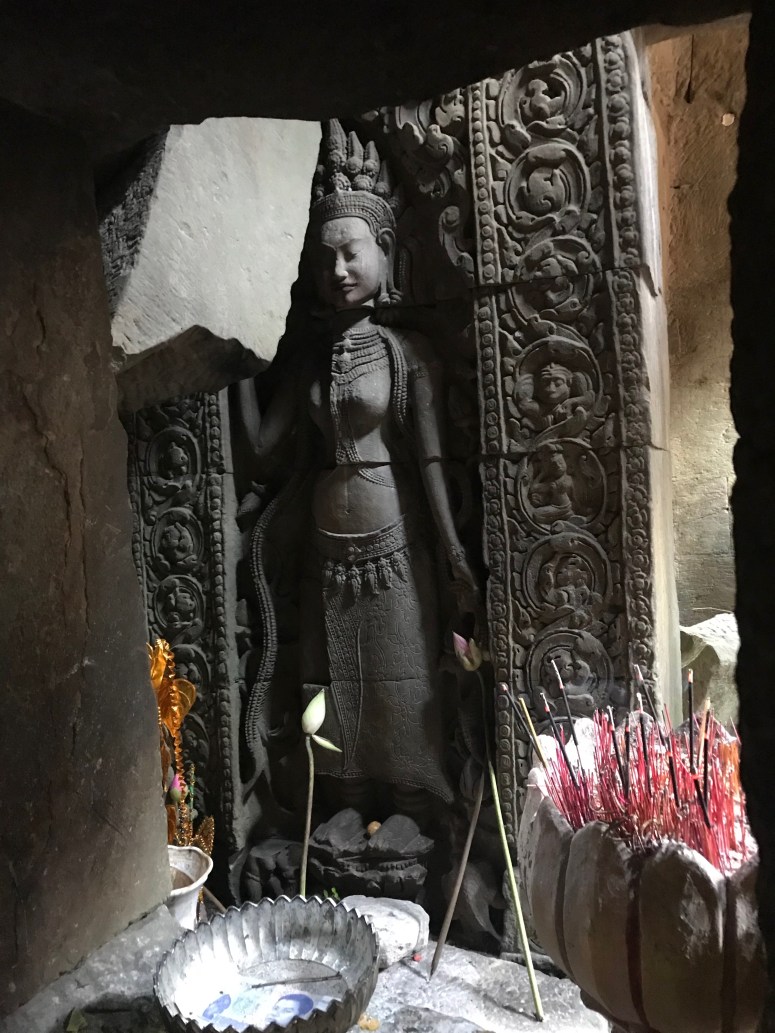
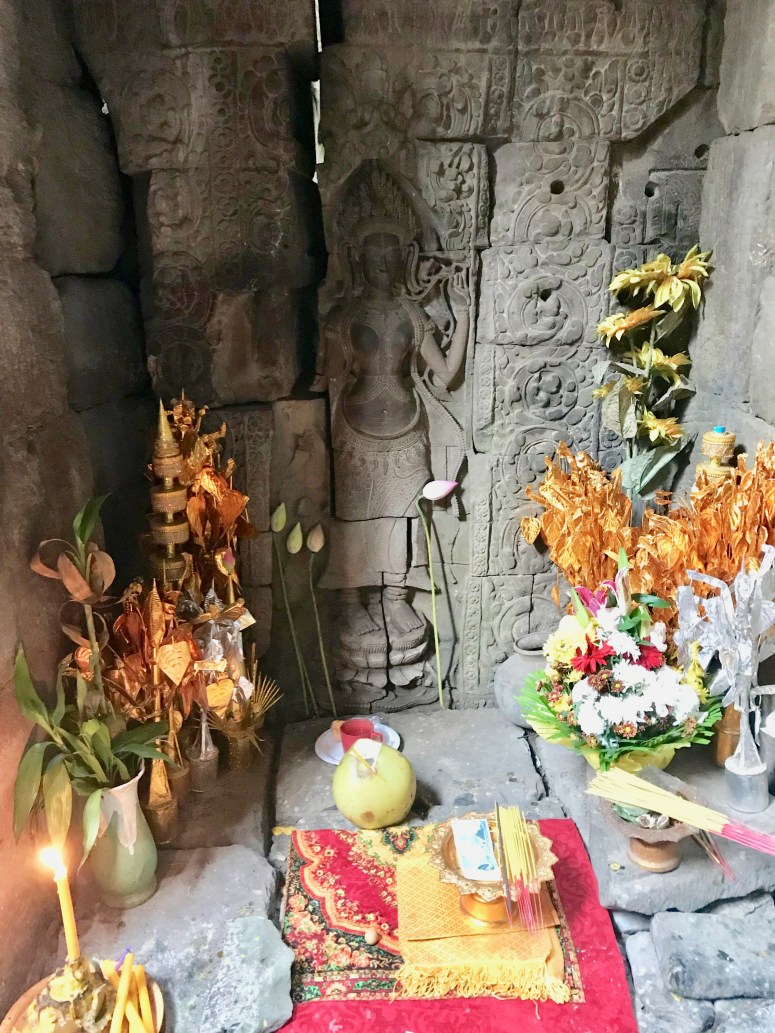
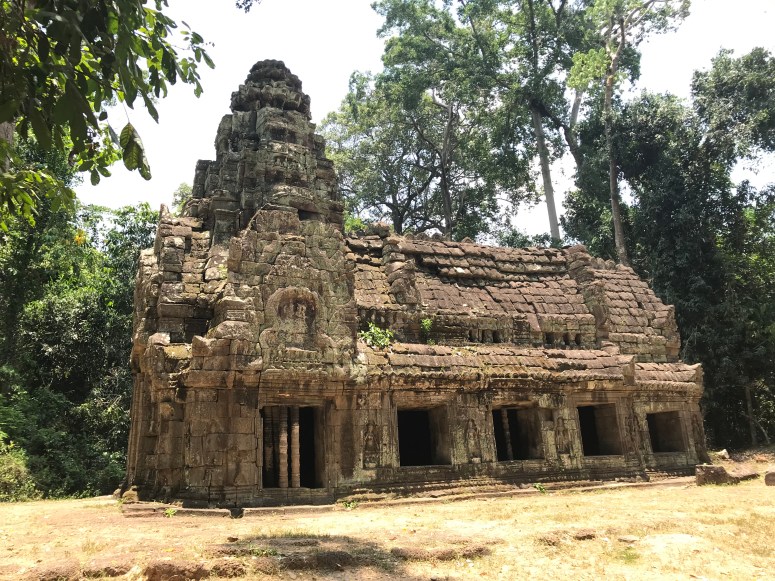
To the east, in the grounds of the temple is an odd two storey building which has a distinctly Greek air about it. I set out to explore it, but was suddenly surrounded by beggars and hawkers in a way that I was far too hot to deal with, so I set off back to the tuk-tuk.
On the way out I came across a vendor selling beautiful temple rubbings on rice paper. She wets the paper and leaves it to dry on the relief and then peels it off and paints the now three-dimensional image. They were very striking. I usually buy an elephant from everywhere I visit, but it is increasingly difficult to find elephants that aren’t commercially churned out tourist tat, and so I bought a rubbing of elephants being used as part of the daily life of the Khmer people, taken from Bayon.
By now it was nearly 1pm and I was hot and exhausted so I suggested to Davin that we call it quits for a while. He dropped me back at the hotel for a nap (I *am* a Nanna, after all!) and we arranged to meet again at 4pm to go and see the sunset at another Wat he recommended.
I think at this point, poor Davin must have been heartily sorry he picked me up at the bus station…! But we met at 4pm and I rode on the back of his motorbike to a Wat on a mountain where, he promised me, there would be a fabulous view of the sunset. We stopped briefly on the way to look at a reservoir which, mysteriously, had a jetty jutting out of one bank, hovering about 20 storeys above the water! I assumed it was some kind of crane platform or a winching point for cargo, but Davin explained that the rainy season is due to start in early May and the weather has been so hot this spring that that’d imply how low the reservoir has fallen. He assured me that, by the end of June, the water would again be level with the jetty. My mind was a little bit blown by this, I have to admit!
Davin drooped me at the foot of the mountain and declined to come up with me. You know why? Because stairs. Yup THERE WERE MORE STAIRS!! I should have mentioned earlier, but every temple was awash with stairs and my watch kindly informed me that I’d hit my goal of 10 flights of stairs by 7:30am. Yup. That many stairs. I am, as you know, a fan of a staircase. Especially one constructed by (probably) slaves from large, irregular blocks of stone. Luckily, I quite obsessively count stairs as I’m climbing them. So I was never bored…. (warning: this paragraph may contain sarcasm).
Anyway, I set off. Up the stairs. There were a lot of them! Halfway up, a ticket inspector asked to see my Angkor Wat pass, which surprised me as Davin had told me it was a pagoda at the top. Still, I showed him the pass, and kept going. The only other people I saw were teenage couples on mopeds. I began to think Davin had sent me to the local kids’ make-out spot. (Turns out he had!)
At the top, I found a distinctly dirty, dingy and slightly odd modern pagoda, attended by an obviously fairly active monastery. It was rather odd, and I really couldn’t see what the fuss was about.


There was a small shrine at the top of a few more steps, shown in the last photo and at first I dismissed it because it didn’t look all that interesting and also, stairs. But i thought I saw something behind the trees and so, since I was up there anyway…
And I found another ancient temple. (Davin did later tell me what it was called, but I didn’t write it down and I’ve slept since then, so my best hope is that he reads this and messages me 😊)


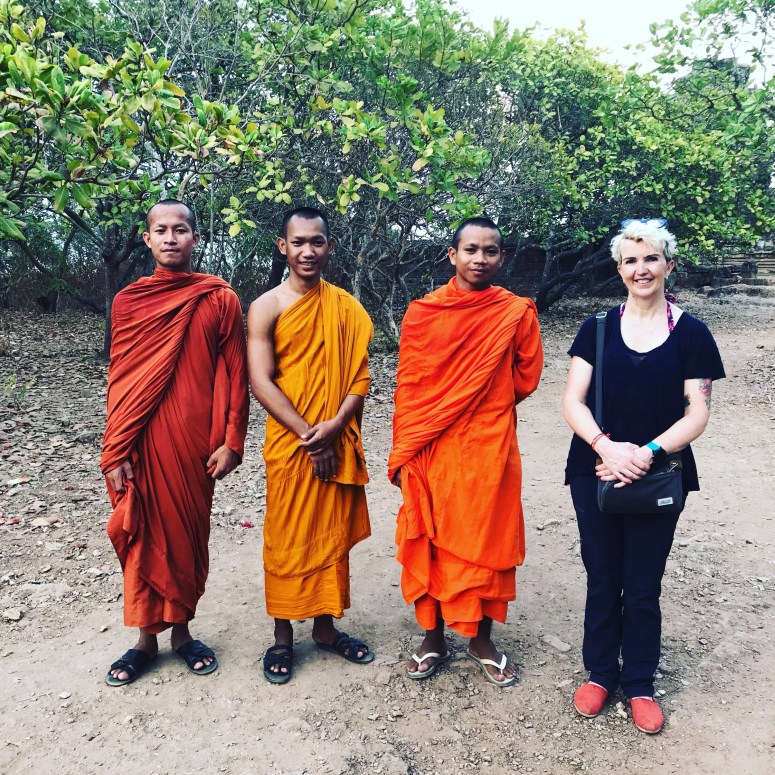
I was virtually the only person there, apart from a small group of monks who had also come to see the sunset and took the opportunity to practice their English. They were all students, and were only at the monastery a couple of days a week. I hadn’t realised you could do part time monking, but apparently it’s quite common – especially for children (they can start as young as 7!!)
Once back down, I got Davin to drop me back into town, where I pootled around for a short while before heading of to Phare for the 8pm show.
Phare is a circus started by young survivors of the Khmer Rouge. It takes young people from “difficult” social and financial backgrounds and educated them, and trains them in music, dance, art and social skills. It is very similar to Cirque du Soleil but with fewer sophisticated props, and 90 minutes there flew by. It was fabulous!! And then I tuk-tuk’ed back to Pub Street and settled myself by a bass stack with a beer and some food, and reflected on my perfect day.
 Hanoi to Angkor Wat (and afterwards)