
I’m perched on a granite bar stool so high I could use it as a kitchen side. I had to use long-dormant actual climbing skills – three points of contact, and all that malarkey – to get up here. The bar stool – and I promise you it is a stool – is on the roof of my hotel in Can Tho, the biggest city on the Mekong Delta. I’ve spent a very leisurely day getting here, and it’s pretty much the hottest of anywhere I’ve been so far. My body is developing a Pavlovian reaction: we go outdoors, it just surrenders all its liquid content in a steady stream from the tips of my ears to the base of my back! I will be utterly dessicated by the time I get home!
There are nine of us on this tour – three Dutch couples, an Austrian couple, and me. One of the Dutch couples includes a particularly strident woman whose name our guide struggles to pronounce. So he calls her Ratty. It makes me smile, because under my benevolent exterior lurks a passive aggressive cow 😊
The Dutch are peeling off tomorrow morning to do different things, while the Austrians and I are heading into Cambodia together.
Sidebar: I ordered lemon juice with salted plums to drink while I type this. It’s just arrived and it is DELICIOUS!
Anyway, we left HCMC at 7:15, headed for Cai Be. It was a couple of hours’ drive and once there we loaded on to a long boat with a domed ceiling and deck chairs. It also contained some dodgy-looking old bicycles. A sight to fill my heart with doom; bicycles and I do not have a particularly happy history!
Our guide, Chau (pronounced Joe but with an initial ch) had talked us through the basics of rice production on the bus. We knew that we are in the dying throes of the dry season and next month the rains will start, and China will open their damn dam and the whole delta from HCMC down to the coast will flood on a regular basis. While this causes a considerable pain in the ass for anyone who has to get around (waters rise to chest height at high tide on a daily basis, some years) it does mean that agricultural production can get going again. At this point in the year, it has basically stopped completely and there is certainly no rice being grown. Anyway, we know that snails are a massive threat to the crop; their eggs are poisonous, but ducks will eat young snails. So many rice farmers also own large flocks of ducks.
We know how rice is planted, grown and how and when it is harvested. We know how it is treated after harvest. We know how ripe particular rice crops need to be before they can be harvested. We know how it’s husked and we know what kind of products are made out of it. We are, basically, rice experts. Next time Port Meadow floods, I’m going to be straight down there with my buffalo.
We are similarly well versed in coconuts. What we lacked explicitly – although I think we have probably all gathered it – is the context for all this. Which seems to be to tell us that the Mekong’s a critically important agricultural region. Particularly, it seems, for rice and fruit – which makes sense, since both crops are particularly intensive.
Our first stop was to load into a sampan boat for a gentle paddle down one of the canoes that abound on the Mekong. The river basically splits in two at the delta, and both main streams are linked by a myriad of canals. All along the waterways, people live in boats and in stilt houses built – often fairly precariously – on the shore. People collect rainwater for drinking, and use the river for all their other needs. Many of the boats have huge eyes painted in the prow – to confuse crocodiles and snakes into thinking the boat is a bigger animal.
The sampans took us down small, narrow waterways along which floated little islands of water lilies.


When we rejoined our boat, we moved a little further downriver before once again clambering off. This time, the bicycles came with us! We were given some brief instructions – drive on the right, stay inside any mopeds, don’t let the rabid dogs – that kind of thing. And off we wobbled. I say wobbled, but if you remember everyone else is basically Dutch. So off *I* wobbled, then. The only thing my bike had going for it was that I could put both feet on the ground. Which helped hugely with both steering and braking! We pedalled through little villages, pausing regularly to admire various fruit orchards. The road surfaces were, at best, precarious and at points were simply sand – which everybody knows is impossible to cycle through, right?? Still, I’m proud to say I kept upright this time, and even managed not to ride over the child who appeared in the middle of the road at one point, demanding high fives from us all…!
Eventually, we reached our destination – a family sweet making business. This was actually far more interesting than I anticipated. We watched them making popped rice (rice crispies, basically) in huge woks containing sand dredged from the river, heated by a fire fed with rice husks. The sand becomes incredibly hot; rice is thrown into it and stirred and pop-pop-pop bada bing!!
After this, the sand is sifted out of the rice and the rice is added to a second enormous wok in which a mixture of coconut caramel and peanuts is bubbling – basically it’s a rice crispie peanut brittle they’re making. And it’s bloomin’ delicious. Elsewhere, they make various rice-based alcoholic drinks. The most revolting of which is fermented snakes. They pull snakes out of the paddy fields and foment them in rice liquor for 4 years. The resulting concoction is said to make men younger and more potent. Personally, I’d stick with decrepit old fart rather than drink that mess once a day… I almost bought some for my father, to see if it was effective. But I am actually quite fond of the auld codger, so… 🤷🏼♀️

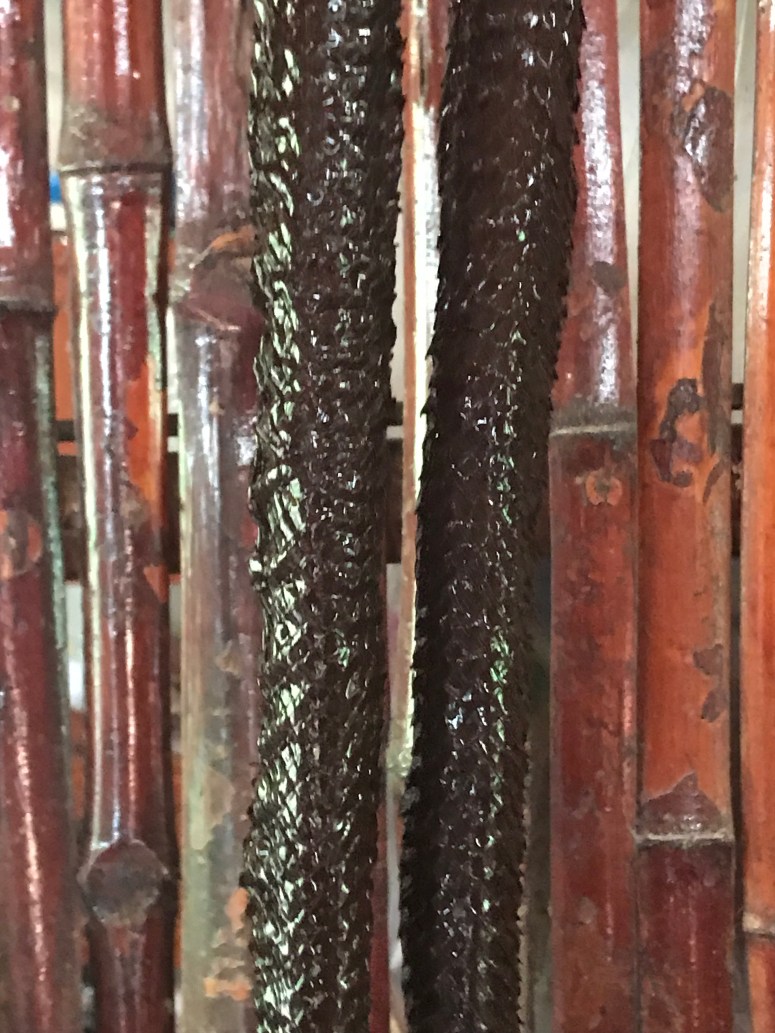
Ugh!!
There was, obviously, an opportunity to sample and buy the confectionary. It was very good – particularly a super fresh type of candied ginger – but if I’d bought it, I’d only have eaten it!
Back on the bikes, we pedalled for another few minutes. I was just beginning to feel like I might master my steed, when we arrived at our lunch spot. We were given lunch by the grandson of a war hero. I know this because there were several commendations from Uncle Ho displayed on the walls, and medals were similarly prominently on view.
After lunch we returned to the boat for another brief trip, this time to a brickworks. Again, the context was about seeing how people live and work on the Delta. Here, a family-run business takes clay dug from beneath the rice fields, and uses it to make bricks, pots and urns. The formed clay is fired in huge kilns, fed by rice husks again, at 50 degrees for four days.
What was extraordinary about this business was not how the objects are made, but the fact that the whole family, including pets and livestock, were running around the factory! It seems extraordinary, to European eyes, to see a toddler playing within metres of these enormous, powerful furnaces! As ever, SE Asia offers a very different perspective!


And then back to the boat. We set off for a delightfully breezy, chilled journey of three hours down the Mekong, with nothing to do but read, snooze, watch the world go by and take photos.
To be fair, there were some extraordinary sights. People using the river for all sorts of things. Transport, obviously, but also laundry, washing (I saw a woman washing her hair, several people bathing after work, a woman brushing her teeth), fishing.


We passed industrial sheds, loading quays, and residential areas. Smart urban waterfronts and tin shacks on stilts nestled up to the river’s edge with – as ever – virtually no physical demarcation between the relative wealth/poverty of the two.


Towards the end of the afternoon, we were greeted by several cheery shouts of “hello!” as children on their way home from school waved and tried to attract our attention, and shortly after that, every rickety pier seemed to have a swimming child beneath it as they cooled off after their day’s studies.


We arrived in Can Tho about 6ish, and after a shower and a change, I set off to find some dinner. I stumbled upon a restaurant called Sao Hom in the covered market area and had the most delicious seafood meal which was basically cooked on a camping stove at my table. The best meal I’ve eaten so far! And now back to the hotel to begin the interminable process of uploading photos on WordPress’ mobile site…


Tomorrow we travel to Chau Doc via floating markets and more cycling (around Tiger Island, this time. And Chau Doc will be my final night in this extraordinary, wonderful country!
 Hanoi to Angkor Wat (and afterwards)