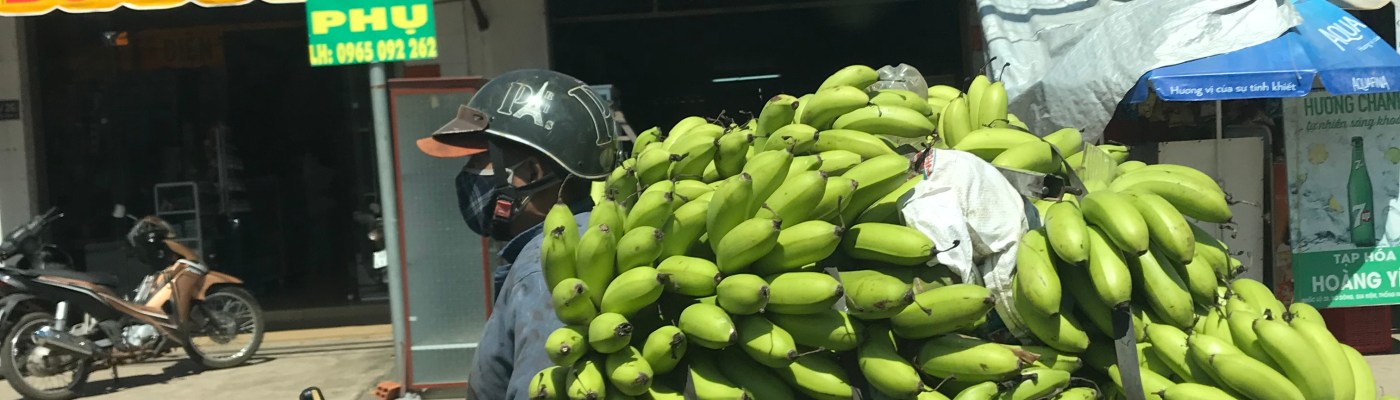
I’m killing time in the car back to HCMC, and I thought I’d write a post about the mundanities that we all take somewhat for granted, just in case it’s of interest. Things I have observed or learned or might have found it useful to know about.
Traffic in Vietnam is – as the Mexican couple I met the other day put it – intense. There’s a t-shirt I’ve seen in several souvenir shops that has a picture of traffic lights on it with the legend “Vietnam Traffic rules: Green – go. Amber – go. Red – go.” It’s certainly confusing to anyone who’s used to a strictly regulated traffic system. But if you observe carefully, there *are* rules – albeit in a looser sense than most European countries! At a red light, most traffic going straight on will stop. Traffic turning into the road will not, however. And do keep an eye out for the odd moped that just can’t be arsed. They do travel reasonably slowly, but you need not to rely on them watching for you – be observant. And observe in both directions. Mostly, traffic keeps to the right side of the road, but not always! So if you want to cross a road, step off the pavement and go for it. This is theoretical advice. You probably won’t be walking on the pavement anyway. Pavements are for parking mopeds and setting up streetfood stalls. Most people walk on the edge of the road. You can often – but not always – carve a path through the back of pavements but you’ll have to divert to the road at some point, so you might as well embrace it.
So, to cross the road, the simplest thing to do is to wait for the traffic to thin, and just walk. I tend to wait until the cars/trucks have gone and it’s only mopeds/bicycles. They are very good at manoeuvring around pedestrians and, indeed, expect to do so – but don’t take it for granted. There’s a lot of driving while texting goes on. Treat every toad crossing as a negotiation…! And if you’re really terrified, wait for a local and slipstream them!
On the subject of negotiation, expect to do it pretty much everywhere. The advice Nga gave me in Hanoi was that if there’s a price tag in a shop, expect to pay that price. And in supermarkets/pharmacies, the price is the price is the price. In restaurants, if the price is stated on the menu, then that’s the price. You can, apparently, haggle with street food stalls but generally the price is so low (120 – 250,000 D is about £3 – £8) that I’ve just paid it. If they’d charge locals a bit less, then fine. Otherwise, haggling is expected and especially in the big markets in big towns you should expect to haggle hard (but keep it good natured!). In shops where there’s no price tag my approach has been to ask for a discount – particularly if I’m buying more than one thing – and perhaps suggest a larger discount if the price is still too high. Know what you’re prepared to pay, and be prepared to walk away if the price remains too high. In the Hoi An shoe shop where I had several items made, I knocked 1m Dong off the price this way (about £32) and we were still both happy with the outcome. I suspect by Vietnamese standards I overpaid slightly, but I got 5 excellent quality, handmade leather items for way less than I’d have paid at home, so….
In a market I’m more aggressive. I usually ask them to suggest the first price and then go for less than half. At the Dong Ba market in Hue – which was really quite aggressive – I was offered 6 garments for $200 (people often quote prices in USD – they assume it’s more meaningful to English speakers). It was a futile offer as I didn’t actually want the items and particularly not at that price (about £150). So I walked. By the time I got to the market entrance, the price was down to $80 (£61) which could have been more tempting but, fundamentally, I didn’t want the clothes. But I wouldn’t enter a negotiation where the start point is so far beyond what I’m prepared to accept – I’m not brave enough to open on way less than half, which is probably a weakness on my part, but there you are!
Toilets. This has featured as a big question in every research site/guide book I’ve looked at. So here’s my take. Toilet provision is plentiful, everywhere I’ve been. There are public toilets in pretty much every public space. For the most part, these are pedestal style toilets. However in railway stations, markets, roadside service stations and some beach locations, they are squat toilets. I imagine this is also true in rural areas. In hotels, museums and restaurants, toilet paper is usually provided – if not in the cubicle then on a “help yourself” basis as you go in. While toilets themselves are usually segregated by gender, the hand wash facilities are shared. There is not often soap and the hand drying facilities are non-existent. So you will definitely want to take toilet paper and/or wipes with you, wherever you go. I’ve found wipes the best option as they’re also very useful for freshening up when you get too hot and sweaty. Plumbing here – as in much of SE Asia is not robust enough for you to flush *anything* other than human waste. There will be a bin beside the toilet for your toilet paper/used menstrual products and anything else you may need to dispose of. There is also a bidet hose for cleaning yourself with. It takes some practice, but is very effective – try to bear in mind that toilet paper is for drying yourself, not cleaning! Otherwise those bins would get horribly stinky!
Shoes – not to be worn inside houses or shops. Make sure you have shoes you can easily slip on/off. Many hotels seem relaxed about shoes in their reception areas, but if you’re staying mostly in home stays, expect to leave your shoes on a shoe rack either just inside or outside the front door. Most places provide “slippers” (flip flops) for indoor use, but barefoot also seems fine. Be careful not to show the soles of your feet to anyone, though, as this is considered offensive!
Tipping. I haven’t, so far – apart from a small tip to the taxi driver who took me round the tombs in Hue. I’m currently agonising over whether or not to tip my tour guide from the last three days. Actually, not whether so much as how much! I worry about being too mean, and so am following guidance from various websites, which is divided between those who say don’t do it, and those who say do. To be fair, it was a reasonably expensive tour so I’m going to assume it’s mostly priced in, but will give *something*, even so. But yes, generally I assume it’s priced in. Occasionally, people will keep the change – particularly taxi drivers, in my experience – and I haven’t bothered to argue about it. But then, I haven’t taken many taxis!
Getting about. I mean, here, within towns. I assume readers are good for sorting their own train/plane stuff! But from place to place within a town – until now, the towns – even Hanoi – have been quite walkable. But then, I’m very fit and walking several miles a day doesn’t phase me. Remember that it’s not only very hot, but also very humid, so you’ll need to carry water with you everywhere you go, and you may want to consider bringing some kind of electrolytes for routine use. I’ve been using an electrolyte tablet designed for runners; at least one per day. I’ve also greatly enjoyed Grab bikes – moped taxis that you book on an app, like Uber. They have the benefit of knowing what you’ll be charged up front, and relatively quick and easy. I found my one experience of taking one out of town (Hue) quite terrifying, though! They will provide you with a helmet. I thought this was an excellent thing, until the medical student I met at Cat Tien told me she’d picked up lice from a Grab helmet. Now, I think I’ll just walk everywhere! For longer journeys, Grab also do car hire. They are metered, so there’s no need to negotiate a price. If you’re going further than Grab want to take you, MaiLinh cars are also metered and pretty ubiquitous. Apparently you’re better off negotiating a price if you want to go great distances, but this isn’t an issue I’ve dealt with. I will just say that if you’re negotiating a price, do it in writing (even on your phone) in order to have a reference point if there’s any re-negotiation at the end of the journey.
Talking of water, the tap water here is NEVER good to drink. Even ice is made from bottled water. To be honest the very briefest research into the use of chemical warfare during the American war should make this self evident. A small bottle of water (350ml) costs 5,000 VND (about 17p) and a 1.5l bottle is almost universally 15,000 VND. So it’s not expensive. Most hotels and BnB/homestay type places leave you a couple of small bottles per day as part of their housekeeping routine.
Safety. I mean, so far this really hasn’t been an issue for me. At all. I do have a personal alarm in my handbag, but… that said, Lonely Planet suggests that Saigon is the place where I need to be most alert to the possibility of things like bag/phone grabs. I tend to wear my handbag across my body and keep it zipped, and my phone is older than most I’ve seen here, so I’ll be cautious but I’m reasonably relaxed…
That’s about all I can think of. But if there’s anything else you’ve wondered about and you think I might know, then feel free to hit me up in the comments!
 Hanoi to Angkor Wat (and afterwards)