So today is jungle day!! This has been the part of the holiday I’ve been most excited about since I booked it!
My guide – Ben – arrived at 8am at the hotel to pick me up, and we wandered out to the street to meet our car. Turns out I’m the only person on this tour, which seems a little profligate, but still…!
Ben explained that it would take four hours to get to Cat Tien National Park – maybe more, depending on the traffic. Cat Tien is an area of lowland tropical forest. Most of it was stripped by napalm during the American war, but fortunately some of the higher canopy survived and it is now 72,000 hectares of the most biodiverse forest in Vietnam. Lonely Planet says apes, monkeys, tigers and elephant as well as amazing flora and fauna. Ben says no tigers or elephants… apparently there *are* over 100 types of mammal here, including guaur, 79 types of reptile, 41 different amphibians and a huge number of birds and insects.
Along the way, Ben chatted animatedly about his family life in the Mekong Delta, and his work. We talked about politics and flooding and education… his English is, he admits, learned largely from films and I think we are frequently at slight cross purposes, but he is enthusiastic and good company, so….
The journey was enlivened by a puncture, which the driver fixed amazingly quickly – the wheel was off, the spare on and we were on the road again within 15 minutes. A couple of miles down the road we pulled up at a shack with a stack of tyres outside, and a mechanic took the wheel and repaired the puncture with similar easy efficiency. Original wheel back on, we went on our way. I confess I had a little zzz at this point, and before I knew it we were pulling up.
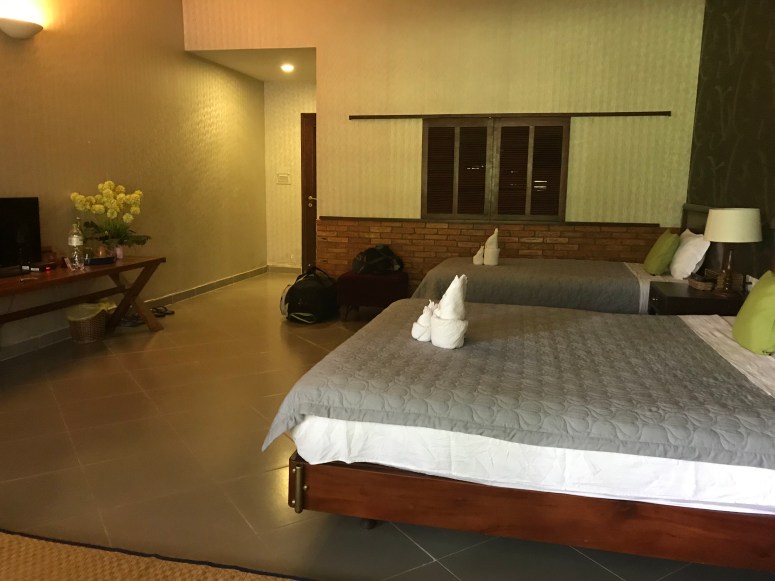
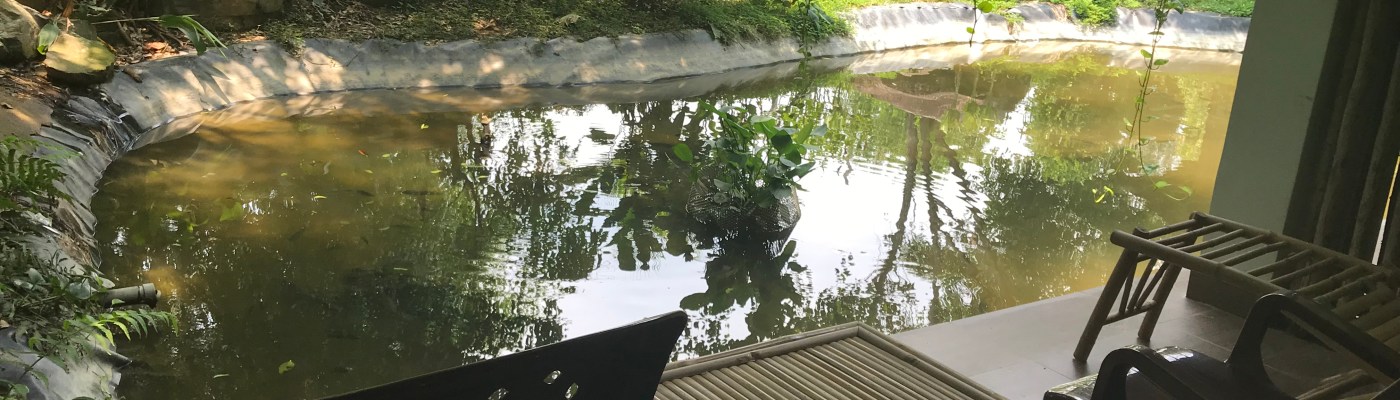
I was shown to my room, which is *huge* and has its own private terrace complete with carp pond. There was a very brief opportunity to wash up, and then lunch was served. I ate in solitary splendour in a balcony restaurant overlooking the front of the property, and then went for a little explore. The hotel backs onto the Dong Nai river, and there’s only a bloody swimming pool, right at the river bank!! I haven’t had a chance to explore it, yet, as I had to meet Ben for the first stop of the trip.
We got a little ferry, along with about 8 other people, to the Cat Tien National Park headquarters, on the opposite river bank. Once there, we were grouped into English speakers and others, and got back on the boat to visit Dao Tien endangered primate centre. Our guide was a lovely volunteer from Hampshire!
Dao Tien takes in gibbons, black-shanked douc and pygmy loris that have been rescued – predominantly from the pet trade. They are initially kept in holding pens before moving to a semi-free environment (where they live as if in the wild but with supplementary feeding and people monitoring their behaviour and adjustment levels). Once the centre is sure they are able to support themselves and live a normal life, they are released into the park at large.
The tour was fascinating – and noisy! Not only did we have the lovely whooping, howling song of the gibbons, but the cicada were also out in full force. They really had to be heard to be believed – it’s like a violent form of tinnitus!
We saw a few caged gibbons and the guide explained that these were being assessed for health and behavioural issues – all apart from two which had picked up the cold sore virus in their time as “pets”. This virus doesn’t occur naturally in gibbon populations and so, while it’s not believed to do any harm, they won’t take the risk of releasing those particular apes.
We then spent a lovely half an hour sitting in a hide watching a young pair of gibbons in a semi-free. They were a male and female pair of juveniles and the guide explained that it’s very unusual for juveniles to live outside a family group, and these two would not be released until they reached maturity. However, they were making very good progress in the semi-free and the team are confident they’ll be able to live in the wild. The male had been the pet of a young girl, who had kept him swaddled, like a baby. As a result, when he arrived at the sanctuary, he had not known how to use his hands! The poor beast not only had to be taught how to eat, but how to climb a tree and swing and, generally, behave like an ape! The guide explained that, even when pet gibbons are treated well as infants, as adults they are quite dangerous, having very strong jaws and an instinct to use them to protect their territory, so it’s not uncommon to find adult pet apes confined to unsuitable cages at the back of classrooms or garages, or wherever it happens to be.
We went to the pygmy loris area, next. The guide explained that we couldn’t see the lorises as they are highly susceptible to stress (and anyway nocturnal) so they don’t allow people to view them. We learned that the current trend for videos showing loris “enjoying” having their tummies tickled has fuelled a trade in them as tourist photo accessories around the world. In fact, they are incredibly shy animals, in whom stress provokes quite a severe reaction, not dissimilar to a heart attack. They’re also extraordinarily able to defend themselves. Their saliva contains an enzyme which makes a wound inflicted by loris bite not only slow to heal, but also likely to develop necrosis. Not only that, but they have a gland on their upper fore-limb which, when combined with their saliva, produces a highly potent toxin. This means that a loris with its “arms” raised in the surrender pose is not “enjoying” the tummy tickle some clueless YouTuber is subjecting it to, it’s preparing itself to lick its toxic gland prior to administering a bite. The solution most often applies to this is to pull the loris’ teeth out. Ain’t people great??
I got talking to one of the other Europeans on the tour, an Italian medical student doing an elective at Saigon hospital while she completed her PhD on dengue mosquitos. We chatted about Oxford and her studies and where she’s been before here. She’d organised herself a boat trip on the river, and asked if I’d like to come along and, to Ben’s slight alarm, I accepted. So we clambered into a slightly rickety boat and set off down the river for probably about an hour and a half.
It was a beautiful journey. We saw kingfishers and storks, huge leaping fish, a monkey (looked like some kind of macaque) and a really beautiful, pale grey bird about the size of a blackbird, with flashes of green around the edge of its tail. I have no idea what it was, but it was almost ghost-like, it was so pale and ethereal. There were also plenty of swallows, darting low over the water to catch their supper. Mariana asked what the English word for them was, and I told her “one swallow does not make a summer”. Turns out in Italy they say “one swallow does not make a spring!”
Tomorrow is a 7am start. We drive into the forest for about 10km and then walk another 5km to get to the crocodile lake. Then back to the Lodge. It’s going to be hideously hot! And once we’re back, I’m going to another conservation project – this time, a bear sanctuary that looks after animals rescued from bile farms (bear bile is used in Chinese medicine, I believe. I’m hoping to wake up to the sound of gibbons calling, before all that kicks off! Exciting times…! But first, I need to spray myself liberally with insect repellant, convince myself that the thing that just scurried along the skirting board is a lizard (NOT a spider!) and get some sleep….
 Hanoi to Angkor Wat (and afterwards)