So. There are some things you need to know, for this post. Prep, if you will…
Tombs (and some temples too, it seems, but let’s focus on the tombs) are elaborately planned for the after-life you should become accustomed to. Certainly this is true of the Kings of the Nguyen Dynasty, some of whose tombs I have visited today. These are tombs more on the scale of the Pyramids, than that of Père Lachaise’s more elaborate mausoleums (mausolea??).
I’m extrapolating a lot of what follows from what I have seen today, so if you are an authority on this subject and I’ve extrapolated wrongly, I’d love you to leave a comment…
Some of the tombs seem to have been extensively used as – at the very least – country residences during their subject’s lifetime. Others are death-abodes only. So some have grounds surrounding the burial site, and I’ll talk about those when I get to them (edit. I don’t. The two fingered typing got too much!). But the layout of the burial site goes like this:
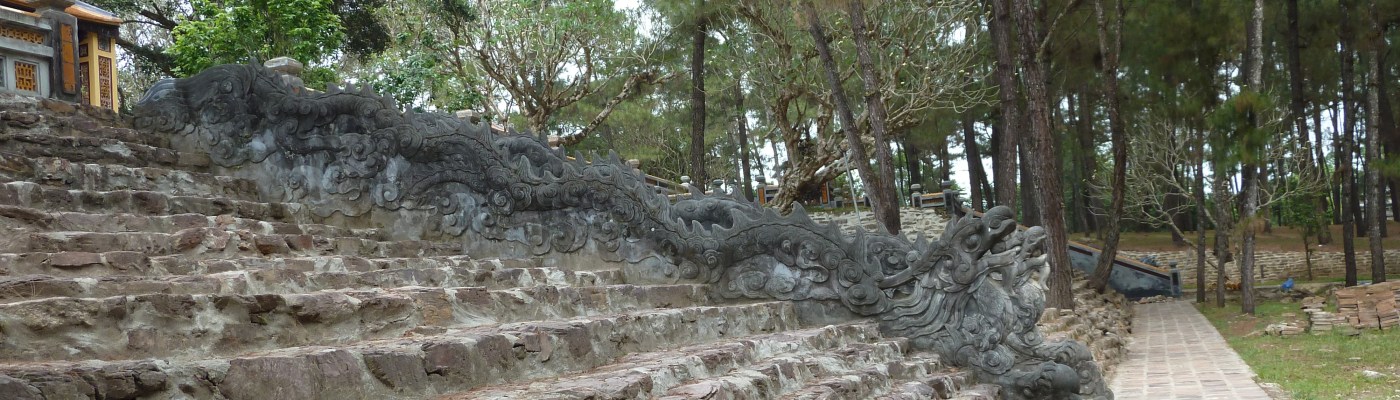
- A staircase to the first level. Elevation seems important. It’s worth noting that if you used forced labour to build your monument, they are going to cut *big* blocks of stone for the steps. Gets the job done quicker, see? So. A big, steep staircase to the entrance gate.
- An entrance gate. This is a triple gate, where the emperor enters through the central gate and mandarins/courtiers/militia and other lesser beings enter through either the left of the right gate, depending on their status.
- A stele pavilion. A stele is a huge stone monument, looking much like an enormous headstone, inscribed with the accomplishments, exploits and virtues of the emperor. Sometimes written by the emperor himself…
- More stairs and another gate (stairs optional. Option usually taken)
- An honour courtyard. This is where the Emperor’s troops, mandarins, horses and elephants hold themselves ready to serve him in the afterlife.
- Stairs. Sometimes fewer. Not often fewer enough.
- A temple for the worship of the emperor and the empress. Sometimes the empress gets a temple to herself. Sometimes there’s also a temple for the “minor wives”.
- An enclosed sepulchre. Sometimes the emperor is actually buried beneath this. I think I’m remembering rightly that this was almost always at the same level as the temple, but you can insert stairs if you like. You will like a lot less after your second tomb.
- A lotus pond with frangipani and pine trees. And carp. HUGE carp. Actually, this is often early in the sequence, and also there’s often more than one.
- Right. So now you know how the tombs work, let’s go visiting!
Actually, before we start, let’s grab a coffee. Tinh had recommended a local coffee shop that sells salt coffee. Yup. That’s coffee with salt in – coconut salt, apparently. Anyway, it’s bloody delicious. I was a little sceptical, but it was really very good. Then, feeling rather blasé, I dialled up a Grab bike. The first visit was Thien Mu Pagoda, a temple 5km out of town. Should’ve thought about that. For a start, the driver was barely out of his teens. I had to concentrate very hard on not thinking about adolescents’ barely developed cortices and reckless attitudes to risk! For another thing, once we left the citadel we were in a 3 lane highway. On a moped. Driven by an adolescent. *You* try not to think about risks…. And potholes are bloody terrifying when you’re trying desperately not to grip your child -driver in a deathlike stranglehold. But we got there.


Thien Mu Pagoda was founded in 1601 by the governor of Thuan Hoa province. Its octagonal tower was built by Emperor Thieu Tri in 1844 and the temple holds a strongly symbolic place in Vietnamese culture and history. To the right of the tower is a stele resting on the back of a massive turtle, symbolizing longevity. To the right, an enormous temple bell which supposedly weighs 2052kg and is said to be audible 10km away.
You then pass through a triple gate, each of whose entrances is guarded by a bearded warrior. Their beards are made of *real hair*, people!! Truly freaky! Inside the gate, each side of the courtyard is watched over by three statues of Buddhist guardians. Also with real hair beards.
At the top of the courtyard is an incense cauldron and then the temple in which sits a huge, glass-encased golden laughing Buddha. Behind him are three more Buddhas: A Di Da, the Buddha of the past; Thich Ca, the Buddha Sakyamuni; and Di Lac Buddha, the Buddha of the future.
Behind the temple is a garage in which is parked a blue Austin. This is the car in which the monk Thich Quang Duc drove himself to Saigon in 1963. When he got there, he set himself alight and burned to death. He was protesting against President Ngo Dinh Diem. They say that when the fire was extinguished, his remains were cremated and when they collected his ashes, his heart was intact. This “pearl heart” is a potent symbol of enlightenment and apparently it’s on display, though I didn’t catch in which museum.
Leaving Thien Mu, I found a taxi (big shout out to MaiLinh taxis, here, for fantastic service!) The driver agreed to drive me for the rest of the day, and we visited three tombs scattered around the villages and another temple before he dropped me back in Hue. All for the princely sum of 550,000 Dong (about £18!!). Far less terrifying than a moped, and with the bonus of air conditioning… The temperature has been up to 34 degrees today, so this was particularly welcome!
Right. I’m going to show you tombs with links to information pages, rather than write about them all, as typing with two fingers and sorting photos is a slow old business. As a quick summary, though, Minh Mang was far and away my favourite. Spectacular setting and beautiful buildings.
Khai Dinh was a spectacular monument to bad taste. I overheard a guide say that they’d never found a spider’s web in there – I’m not sure they’d spot one in all that baroque over-embellished noise, but I suspect no self-respecting spider would be seen dead in there (d’you see what I did there??) Also. Check out the googly eyed dragons. What’s that all about?!
Tu Duc was also a country residence and was set in lushly beautiful landscape. Spoiler alert, though: Tu Duc isn’t buried there. He’s buried with great treasures in a secret location, apparently. The 200 servants who interred him were all beheaded as a small token of gratitude for their labours.
So. Here they are:


The last two images are the tombs of Tu Duc’s adopted son (penultimate) and empress (final).
My last stop was very special – the Tu Hieu Pagoda, home of the Zen master, venerable Thich Nhat Hanh. This is the temple where he completed his training in the 1940s before spending over 40 years in exile. He returned here last year. While I (obviously) didn’t see him, it was very special to spend time there.
The temple is fairly modest, although there was a lot of building work going on. Much of the monastery is not open to visitors, but the community of monks and mind who live there was very much in evidence.
The temple gate is well populated with beggars and hawkers, but once through there is a beautiful carp pool.
Climbing through the forest, you first come upon the graves of the eunuchs from the citadel, who claimed the temple for themselves. There is also a huge temple bell.
Being a working monastery, there’s very little in the way of guides or labels, but here are some pictures…


And that’s it. A very lovely, very hot and very exciting day! And some stairs!!
I finished up with some shopping – more climate appropriate clothes, and some gifts. And when I got home, I found Tinh making peanut butter, and had an impromptu lesson in how to do it!
 Hanoi to Angkor Wat (and afterwards)